Showing posts with label WATER HEATER. Show all posts

How to Install Tankless Water Heater?

Started by inspecting the previous traditional tank-type water heater installation.
After shutting off the gas and water valves, we unhook the gas and water hookups, then drain the water heater of water.

After moving the previous tank-type water heater we are ready to begin installation of a new energy efficient tankless water heater. We begin by installing new shorter water pipes through the floor to the basement, using the previous holes in the floor. We screw two foot long 2" x 4" pieces of wood to the studs inside the wall, giving us a secure place to mount our tankless water heater. We then use Stainless Steel Wound Water hoses to go to the cold water intake and hot water output. Our tank-type water heater left a great place for our new Dual-Chamber Intake/Exhaust Flue Pipe.

After the install was complete, Jim held the exhaust after 15 minutes of run time to show how the Dual-Chamber Intake/Exhaust Flue Pipe creates very little heat along the pipe.

Our mission was complete in one afternoon, completed by three guys with general knowledge in plumbing and construction.

Selections of Water Heaters are Suitable for you

Using a water heater or water heater is necessary for some people, like us who are not "strong" to bathe with cold water.
But sometimes, it is not easy to choose what type of water heater that suits your needs and also of course "our pocket".
Here we try to discuss the above matter so that we can determine the right type of water heater.

Types of Water Heaters available:

Storages Water Heater.
This type (which uses the storage tube) is the most commonly used and generally uses electricity or gas as a source of heat. And use of gas is usually cheaper than electricity.

Because using the tank (storage), the thing you need to consider is the need for water to be used and the more it means you have to choose a larger tank and the bigger places you need to put the tank.

The advantages of this type is the hot water will be available at any time because the water in the tube will be periodically heated but on the other hand, the cost of electricity per month for this type greater than among others.


Thankless or on-demand water heater.
Type this one will not store water but immediately warmed through coil units that exist at the time you will use.

The advantages of this type is the cost of electricity per month is smaller but on the other side to get enough heat, electric power in the house should be large enough.

The drawback of this type is the availability of hot water can not always be provided, especially for users who want to use hot water continuously and in large numbers.


Solar Water Heater.
Type of this one was the most power-efficient because it uses solar energy as a heat source but for the price of this tool is much more expensive than other types.

The drawback is that installation is more complicated (placed on the roof of the house) and the heat generated will depend on the heat of the sun that is so, if possible, choose a solar water heater has a backup power when the sun is not "friendly".

Rinnai R75LSi Tankless With his review

Rinnai R75LSi Natural Gas Indoor Tankless Water Heater


Price:$900


The Rinnai R75LSi Natural Gas Indoor Thankless Water Heater is possibly the most popular thankless heater on the market today. It was designed to be able to present a whole home hot water solution for instant and limitless hot water for most American homes. It’s not the cheapest model, and it doesn’t have the most features, but it was never designed to have either. It was designed to do a great job for most homes at a good price. Does it succeed? Lets have a closer look.

About Rinnai and the Warranty
Rinnai are a company that specializes in gas hot-water appliances, and have been around for over 90 years. Success in their field for so long has led to a well-deserved reputation for quality. As a case in point Rinnai offer one of the best warranties out there – 5/2 year labor and parts warranty for commercial use and 12/5 year for residential. On the whole one of the advantages of Thankless water heaters over storage is the longevity you get with thankless.

Installation
One of the key features of this model is a good compact and simplistic design, so the Rinnai R75LSi can fit virtually anywhere. The whole unit is only 14 inches x 10 inches x 26 inches, and is a fashionable brushed aluminum in finish – not that you’ll likely be spending much time looking at it. As well as the obviously needed natural gas line in, water supply in, electricity in, and hot water out, you’ll need to put it next to an outside wall so it can vent out. That said its compact nature means you can easily mount in pretty much any indoor space that meets the above.

Ease of Use
Once installed, this unit is easy to use, with a “Goldilocks” level of features – not too many, not too few.
Lets have a look at a diagram of the control panel that you will see on the water heater:
  • “In Use Indicator”. This is juts a light that indicates whether it is being used at present
  • “Temperature display”. What temperature you want the water heated to
  • “Temperature Selection”. Change the water temperature up or down
  • “Priority”. In unusual circumstances, you might have more than one of these heaters installed in the building. In that situation this button and light is used to indicate which water heater is used to set the temperature. Most people won’t ever have to worry about this button.
  • Errors. If there is a problem and the water heater isn’t working, the temperature display will display an error code which you can use to look up the appropriate code in the user manual. The error detection here is very good with about 20 different codes, so on the off chance something goes wrong there is an excellent chance you’ll get a useful idea of what it is.
So as you can see once it’s installed there’s nothing to do except adjust the temperature now and then is desired.

How does it Perform?
Let’s open up the Rinnai R75LSi natural gas thankless water heater and see how it performs. Far from a unit for small homes, this device can crank out 7.5 gallons of hot water per minute, and so can very effectively handle a 2-3 bath home. Using dual showers and hot water in a sink at the same time will never have you screaming in a cold water blast. And this unit can maintain that level of volume even while you have several faucets running, or appliances using hot water lines. That is not just initial flow. Very good volume and heat consistency.
Just mount the Rinnai R75LSi in any room where you can vent it outside, and you don’t have to worry about messy traditional water heater pans to empty. This unit cleverly has a built-in condensate collector, and handles removal by transforming to water vapor and sending right out of its vent. This unit also cleverly uses a commercial grade heat exchanger instead of typical residential device. This means that the heat it generates is constantly recycled, there is no wasted heat.
The water heat can be regulated from 98 to 140 degrees., and it is all done digitally at the master control panel mounted into the unit itself. And should you have extreme hot water needs, these systems easily piggyback each other, with an EZ connect feature. As your family grows and your needs change, don’t worry about installing a whole new system, just add another unit.
This unit can also be installed in manufactured (or mobile) homes, making it the most versatile water heater we know of .

Saving Energy and Money
Tankless water heaters cost more money upfront than a tanked water heater. It’s all about saving you money in the long run. So it’s important to have features that save you money down the track
  • Earlier we mentioned the commercial grade heat exchanger. This is a biggie as the generated heat is recycled and not wasted
  • Electronic Ignition. What this means is that there is no pilot light running and using gas 24/7. The gas is ignited by electrcity
  • Energy Star rated.
  • Meets California and Texas NOx emissions standards.
Many users have reported savings of up to 84% off of their water heating bill, and overall utility bill savings of 15% to 30%. This means the Rinnai R75LSi natural gas tankless water heater pays itself off in as little as 2 to 3 years.

Stiebel Eltron Tempra 36 Plus Electric Tankless With his review

Stiebel Eltron Tempra 36 Plus Electric Tankless Whole House Water Heater


Price:$750


One of the problems that Tankless heaters can have are variations in water temperature as several people use hot water at the same time. The Stiebel Eltron Tempra 36 Plus Electric works very hard to solve this problem by continually adjusting the water flow so that the temperature remains constant throughout. What this means is you can have several hot showers going at the same time and not need to worry about temperature changes.

Stiebel Eltron specialize in hot water products and have a reputation for producing some of the most advanced water heaters on the market today.Originally from Germany, they have been very successful in the US market for over 30 years.

More about the Tempra 36
The Stiebel Eltron Tempra 36 Plus is designed to replace your old tank heater and should be able to handle even the largest houses without a problem. Since this is their largest tankless water heater, it is ideal for houses, condos, apartments and even small commercial applications too.

It has a space-saving form-factor design, features the latest in heater technology and has great energy-saving features. It can handle up to 8 gallons of water per minute and is one of the most powerful water heaters available today. It is a 36kw unit and is mainly used in high flow-rate situations or cold temperature areas. Since it is 99% efficient you will easily save 10 to 20 percent of your home’s electricity bill if you replace your old heater with this one.

One of the worst things is to have cold water one second and boiling hot water the next. We’ve all experienced that and it’s no fun. The Tempra 36’s temperature regulation is microprocessor-controlled and this ensures consistency, accuracy and precise control over the temperature you want. The dial and LCD display allow you to select between a range of 86 and 140F. Additionally, it will automatically compensate for higher or lower incoming temperatures or any changes in the flow rate too. Smart.

Obviously it does this by adjusting the temperature of the thermostat to maintain the same temperature at all times. However, when the flow rate of the water gets too high, the unit will adjust the pressure so the heater is not overtaxed. This prevents you from having to purchase a big, expensive heater to handle occasional flow rate peaks.

Compared to gas-type heaters, this unit is cheaper to buy, easier to install, requires no venting, is way more efficient, uses less energy and heats up quicker. It’s heating is done in 3 stages to provide maximum versatility and speed when heating water of varying pressures and temperatures. This allows it to handle the crazy demands of two showers and a kitchen sink with ease. Since it is a tankless heater it is not subject to seismic code whatsoever so you don’t have to do any extra construction.

As always your tankless hot water heaters should be installed by a qualified installer. If you need one, you can click here to get a free quote on installation.

Stiebel Eltron’s reputation is unparalleled so you can rest assured that the Tempra 36 will last you many years of unhindered service. It comes with a 3-year warranty on all the parts so you can be sure that they stand by their word. They have been making electric heaters since 1924 but the Stiebel Eltron Tempra 36 Plus sets a new standard for tankless water heaters.

This is electric, so it will cost a little less to install. But really when it comes to gas or electric you should choose what is best for your home. So don’t get seduced into buying electric if you already have gas installed and it turns out it will be cheaper to run.

Another nice little feature we like is that this heater takes up very little space. So those of you in apartments or for some other reason have limited space will really appreciate this.

EZ Deluxe and Rheem RTG-53PVN Tankless With his review

EZ Deluxe Tankless Water Heater, Indoor


Price: $474.95


Technical Details:
3.4 gpm at a 45F temperature rise
88% efficiency and superb combustion performance
Advanced sealed double-chamber forced air intake/exhaust
Key Touch water temperature settings and on-off switch with easy to understand digital display
Aesthetically pleasing and simple design

Product Description:
The EZ Tankless Water Heater EZ Deluxe uses a Direct Vent Intake/Exhaust system. EZ Deluxe is a perfect choice for an energy conscious home that uses no more than 2 hot water sources at a time.

Water heater Review, Comparison, and Opinion:
The fez deluxe has a more efficient and advanced exhaust. The Rheum pulls inside air out of your house exhausting cool air in the summer and hot air in the winter. This hidden ariable is not accounted for in any efficiency ratings. Bottom line = The EZ deluxe wins our review hands down. Performance/ Exhaust/Safety . Please look into the recall for the units that do not have forced balanced exhaust.


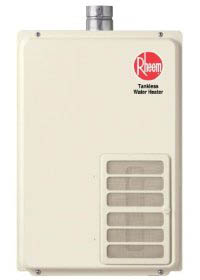
Rheem Tankless Water Heater RTG-53PVN, Indoor


Price: $669.47


Technical Details:
5.3 gpm at a 45F temperature rise (up to 6.8 gpm at 35F)
Electronic ignition increases efficiency
Exclusive! Guardian SBT sensing burner technology overheat film wrap
A remote control thermostat is included with all models with 100F - 140F setpoint range
Digital display on thermostat shows temp

Product Description:
Rheem Tankless Water Heater RTG-53PVN uses indoor air for the intake.
The Rheem RTG-53 series water heater will work in homes with 1 or 2 bathrooms

Water heater Review, Comparison, and Opinion:
The ez deluxe has a more efficient and advanced exhaust. The Rheem pulls inside air out of your house exhausting cool air in the summer and hot air in the winter. This hidden ariable is not accounted for in any efficiency ratings. Bottom line = The EZ deluxe wins our rewiew hands down. Performance/ Exhaust/Safty . Please look into the recall for the units that do not have forced balanced exhaust.

Checking the Gas and Electric Water Heaters For Safe

In Gas Heaters

you should open the combustion chamber and have a gander inside.

First, turn the control to pilot. That way, you don't get your face singed. Then remove the outer hatch -- with gloves or pliers, if the tank has been firing. Then do the same with the inner cover, if it's an older heater. If it was made since 2004, you may only be able to peer as best you can through a small window.

What and where are the hatches? At the base of the heater, perhaps below the control, as here. This outer hatch, top photo, has two tabs that fit in two slots at the top. Others we've seen have the slots and tabs at the side. The inner hatch, below right, merely sits in the opening to the combustion chamber.

Shine a flashlight inside, onto the roof of the chamber. What does it look like? If the tank is sound, there shouldn't be much to see, except maybe some white marks from condensation.

If, however, the tank is headed for ruin, there will be signs of heavy rusting and pitting around the flue, rust flakes on and around the burner, and marks of water having run down the sides.

If you find these marks, begin shopping for a new tank, because yours probably doesn't have much life left. And don't forget to profit the new one so you don't have to do this again.

The first two pictures below are from our own water heater, now 30 years old after being maintained as we advocate here. It is not a perfect tank bottom; we've seen better. But it's a very good one. This heater may yet weep at our funeral. As to the third one, it wasn't so good. We wept at ITS funeral!

When you've finished your inspection, replace the hatches and BE SURE TO TURN THE CONTROL BACK TO ON. Otherwise, you or someone else will eventually be in for a cold shower.

In Electric Heaters

it's not quite as straightforward. There isn't a combustion chamber. But you can turn the power off and inspect all the fittings and open the element ports, left, and the port for the power cord on top of the tank, right. Look for signs of leakage and longtime corrosion.

Make sure the power is really off!

And when you're done, put everything back together the way you found it. It can affect the operation of the heater. Don't forget to turn the power back on or you'll have a cheap thrill the next time you take a shower.

About Solar Water Heater

Solar water heating is a technology that every homeowner can use to save dollars on utility bills. Questions most frequently addressed to the Florida Solar Energy Center (FSEC) about solar water heating are answered below. Please note that many replies are general and more explanation may be required for those with individual questions. For additional information, contact the FSEC Public Information Office, call a solar dealer, or consult the references listed.

What is a Solar Water Heater?
A solar water heater uses the sun's energy rather than electricity or gas to heat water, thus reducing your monthly utility bill. When installed properly, solar water heaters are more economical over the life of the system than heating water with electricity, dedicated heat pumps, heat recovery units or propane.

In Florida, three types of solar systems are used: pumped, integral collector storage (ICS), and thermo-siphon. The direct circulation system (see Figure 1, page 2) circulates potable water from the water storage tank through one or more collectors and back into the tank. The solar collector is the main component of the solar system. It is usually a metal box with insulation and a black absorber plate that collects solar radiation and heats the water. The circulating pump is regulated by either an electronic controller, a common appliance timer, or a photovoltaic (PV) panel.

In integral collector storage systems, the solar water storage system is built into the collector. The potable water in the collector unit is heated by the sun and delivered by city or well water pressure to an auxiliary tank (which contains non-solar back-up heating) or directly to the point of use.

A thermosiphon solar water heating system has a tank mounted above the collector (normally on the roof) to provide a natural gravity flow of water. Hot water rises through piping in the collector, which is mounted below the tank; heavier cold water sinks to the lowest point in the system (the collector), displacing the lighter hot water which rises to the tank.

The ICS and thermosiphon systems are simple since they use no pumps or controllers and water always flows through the collector.

How do solar water heating system work?
As sunshine strikes the collector, the water inside it is heated. If the circulating pump is regulated by a PV panel, the pump starts turning as the PV panel is activated by the same sunshine. This direct current (DC) motor pump moves water from the tank through the collector and back to the tank. As the sun's intensity changes throughout the day, the circulating pump also changes its speed accordingly. By the end of the day, the water in the tank has been circulated many times through the collector and has been heated to usable hot water temperatures.


If the circulating pump is regulated by an electronic differential controller, a sensor at the outlet of the collector and a sensor at the bottom of the tank (Figure 1) activate the circulating pump when the water in the collector is about 15-200 F warmer than the water at the bottom of the tank. The pump then circulates water from the collector and the tank. This process continues as long as the water temperature at the collector outlet is about 50 F higher than that in the bottom of the tank. If the temperature difference decreases further, the controller automatically shuts off the pump.

Common appliance timers also may control system operation. The timer is set to operate during a period of the day when solar radiation is available to heat the potable water. It is important that the timers used in these systems incorporate battery back-up in the event of power failures. In order to avoid loss of energy from the tank during overcast days, the collector feed and return lines are both connected at the bottom of the storage tank. During normal operation, natural stratification allows the warmer water to rise to the top part of the tank.

During periods of insufficient sunshine or high hot water demand, a backup electrical element in the storage tank heats the water. The check valve prevents heat loss when the circulating pump is off. The circulating pump consumes only a small amount of electricity — around $5 to $10 worth per year, or in the case of PV — none.